

Teaching & Learning
At Erasmus Darwin Academy, we believe that excellent teaching makes a difference to every student's achievement.
Our approach is built around high expectations and an ambitious curriculum, supported by a consistent approach to teaching and learning across the Academy. Teachers use their professional judgement to ensure that learning is purposeful, appropriately challenging and responsive to students' needs.
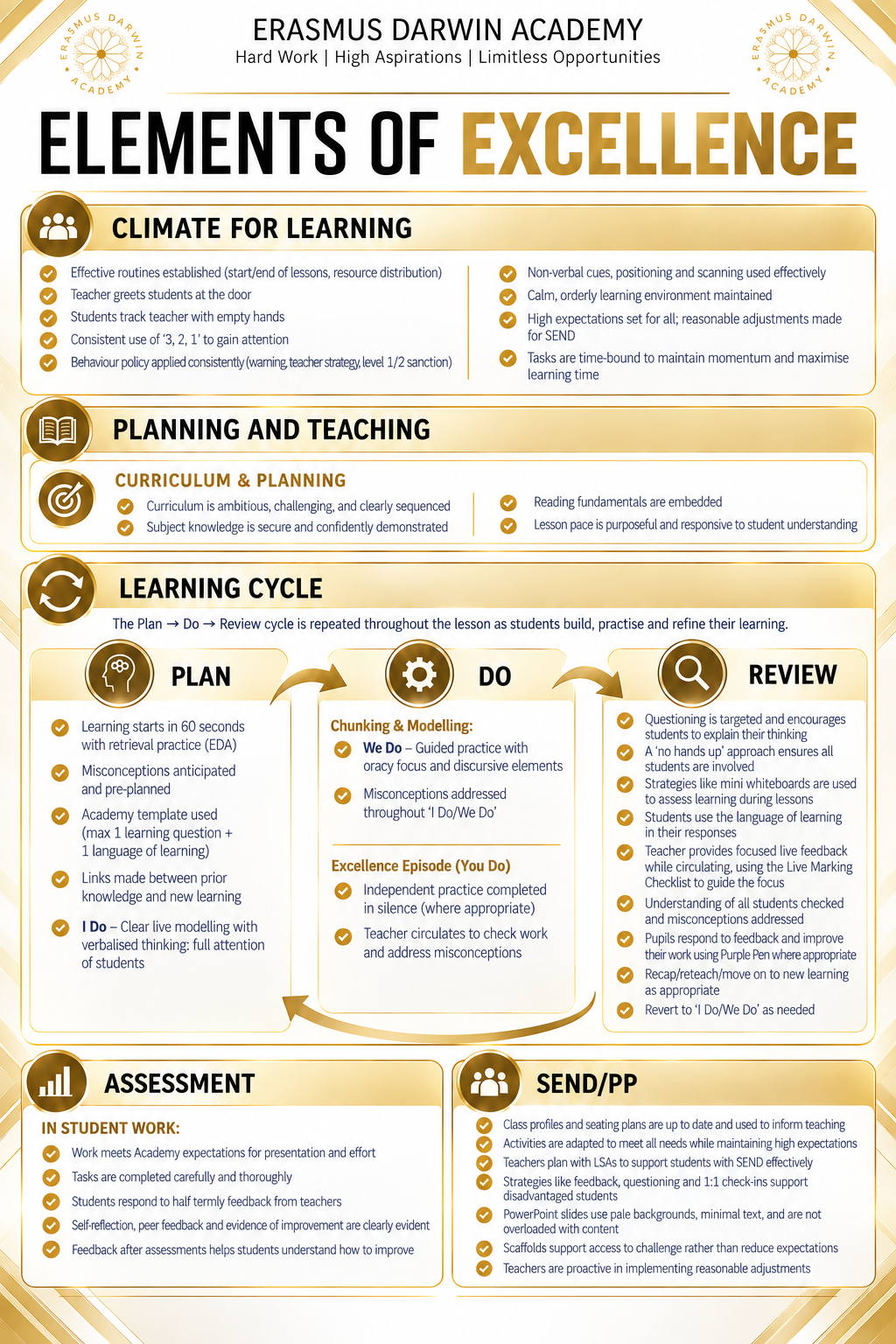
Our Elements of Excellence
Our Elements of Excellence provide a shared framework for high-quality teaching and learning across the Academy.
They set out our expectations for classroom practice, from establishing a positive climate for learning through to assessment and support for individual needs.
They provide consistency across the Academy while allowing teachers to use their professional judgement and respond to the needs of their subject and students.
[View our Elements of Excellence framework]
Our Learning Cycle
Our Plan → Do → Review Learning Cycle sits within the Elements of Excellence and provides a simple way of thinking about how learning develops.
The cycle is repeated throughout lessons as students build and refine their learning. It is not a fixed lesson structure; teachers move through and between the stages in response to students' understanding. T&L Gov Update Oct 2026
PLAN – Prepare for Learning
Teachers establish what students already know and connect this to new learning. Prior knowledge may be revisited, misconceptions anticipated and new ideas introduced or modelled so that students are ready to move their learning forward.
DO – Develop and Apply Learning
Students develop their understanding through purposeful practice. This might involve guided practice, questioning or discussion before students apply their learning with increasing independence.
An Excellence Episode provides an opportunity for students to apply their learning independently and demonstrate what they can do.
REVIEW – Reflect and Respond
Review is an ongoing part of learning. Teachers check understanding and respond to what students know and can do, while students are encouraged to reflect on their own learning and use feedback to improve.
What is learned through Review informs what happens next. Teachers may revisit learning, provide further support or move learning forward, meaning the cycle remains responsive rather than linear. T&L Gov Update Oct 2026
Adaptive Teaching and Questioning
Adaptive teaching is an important focus of our professional development. We maintain high expectations for all students while adapting teaching in response to their understanding and needs.
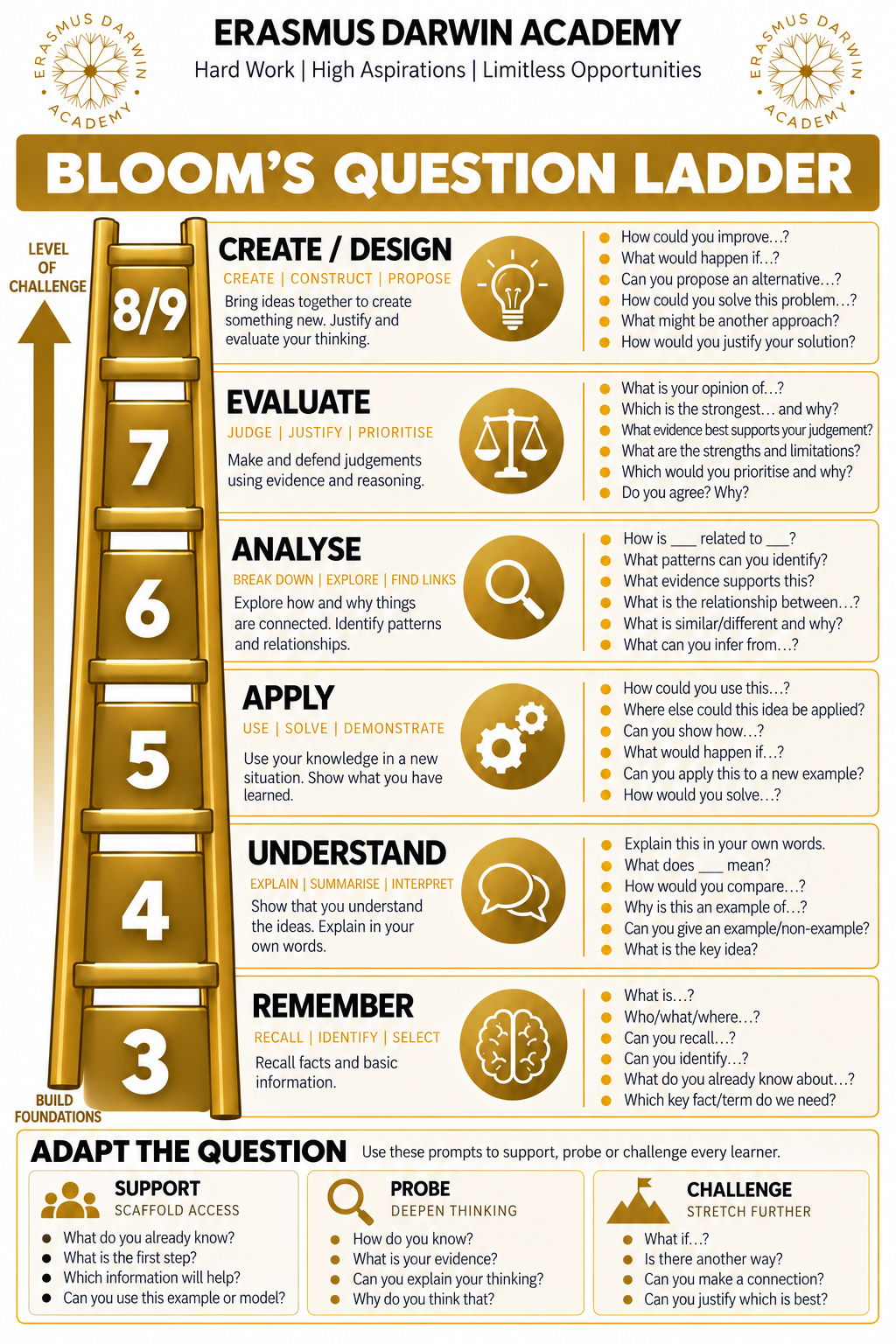
Our Bloom's Question Ladder supports this approach by providing a shared framework for questioning. It helps teachers consider the level of thinking required and use questions to move learning beyond recall towards deeper understanding and application.
The ladder also encourages teachers to adapt the question. Questioning can provide support when a student needs help to access learning, probe understanding more deeply, or increase challenge when a student is ready to move further. Large version Question Ladder
In this way, questioning supports adaptive teaching while maintaining ambitious expectations for all.
[View our Bloom's Question Ladder]
Active Thinking and Participation
We want students to be actively engaged in thinking about what they are learning.
Alongside effective teacher explanation, students need opportunities to contribute, explain their thinking and apply what they have learned. Our current focus is therefore on increasing meaningful participation and ensuring that students take an active role in their learning.
Assessment & Feedback
Assessment helps us understand how well students are learning and what needs to happen next.
Teachers use evidence of learning to identify gaps or misconceptions and adjust subsequent teaching. Feedback supports students in understanding how to improve and, importantly, gives them opportunities to act on that feedback. T&L Gov Update Oct 2026
Supporting Every Student
Our expectations are ambitious for all students, including those with SEND and those who are disadvantaged.
Teachers make appropriate adaptations so that students can access the curriculum successfully without reducing expectations. Support is responsive to individual need and is designed to help students become increasingly confident and independent.